Can Your HOA Prove Where Its Authority Comes From?
Before a material decision, an HOA board should trace the controlling authority through the full hierarchy and show its work.
← Back to Resources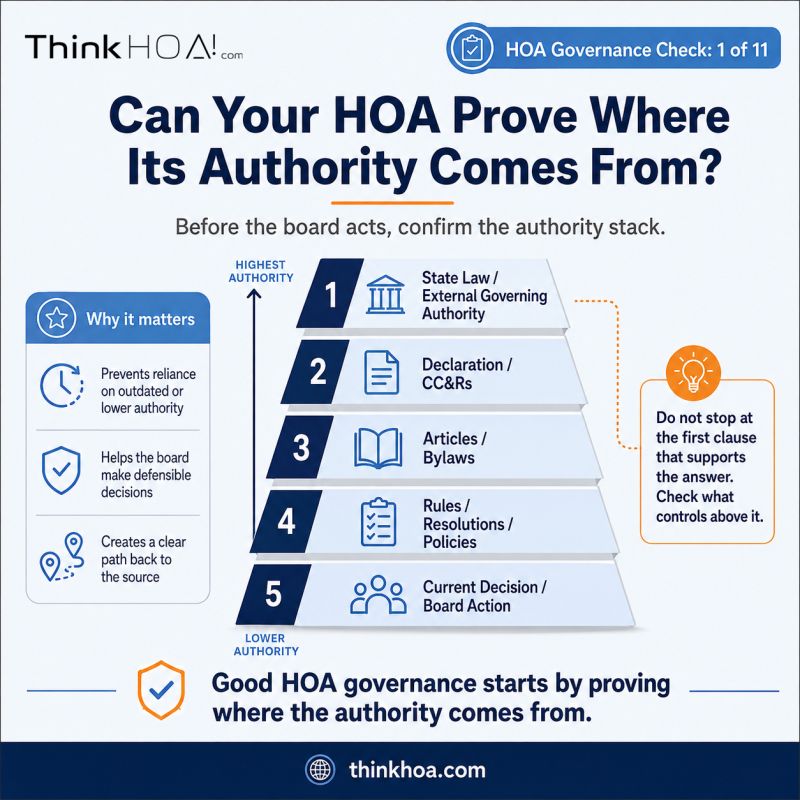
Before a material decision, an HOA board should trace the controlling authority through the full hierarchy and show its work.
← Back to ResourcesOne of the easiest mistakes an HOA board can make is finding language that supports what it wants to do—and stopping there.
A provision in the rules says one thing. A paragraph in the bylaws seems to back it up. Someone remembers that the board has always handled the issue this way.
That still does not answer the most important governance question:
Where does the board’s authority actually come from?
For a material decision, I think a board should be able to trace the answer through the authority stack before it votes.
That means identifying the sources that actually apply to the issue: applicable law, the declaration or CC&Rs, articles, bylaws, rules, resolutions, recorded maps or plats, contracts, and any other governing authority that matters to that particular association.
Then comes the part that is easy to skip:
Do not stop when you find language that supports the answer. Check whether a higher source changes it.
A board-adopted rule may look perfectly clear until a declaration provision limits the board’s authority. A bylaw provision may answer a procedural question until applicable state law changes the result. A contract may assign an operational responsibility without giving the board authority to change an owner’s rights under the governing documents.
The exact hierarchy can vary by jurisdiction, association type, and governing documents. That is precisely why the board should be able to show its work instead of relying on habit.
“We’ve always done it this way” is not an authority citation.
Historical practice matters. Prior decisions matter. Consistency matters.
But precedent should help explain how the association has applied its authority—not replace the authority itself.
If a new director joined the board tomorrow and asked, “What gives us the right to do this?” somebody should be able to answer with more than institutional memory.
A simple board-level check can be:
Authority: Declaration §__ → Bylaws §__ → Rule/Policy dated __ → applicable law checked __.
That one line forces the board to identify the chain before the decision becomes precedent.
The difference between an informal board habit and a defensible governance decision is often the ability to show where the board’s authority came from.
That is one of the ideas behind ThinkHOA: organize the authority first, then connect the decision, history, precedent, and outcome to it.
Good governance is not about finding a sentence that gives you the answer you want.
It is about knowing what controls before the board acts.
Educational governance resource only. Specific legal requirements and authority hierarchy vary by jurisdiction and governing documents; material or disputed legal questions should be reviewed with qualified counsel.
Continue through the ThinkHOA meeting resource cluster: