HOA Tradition Overrides Documents
For years, an HOA relied on tradition to assign deck responsibility—until rotting railings exposed why governing documents must be read in full context.
← Back to Resources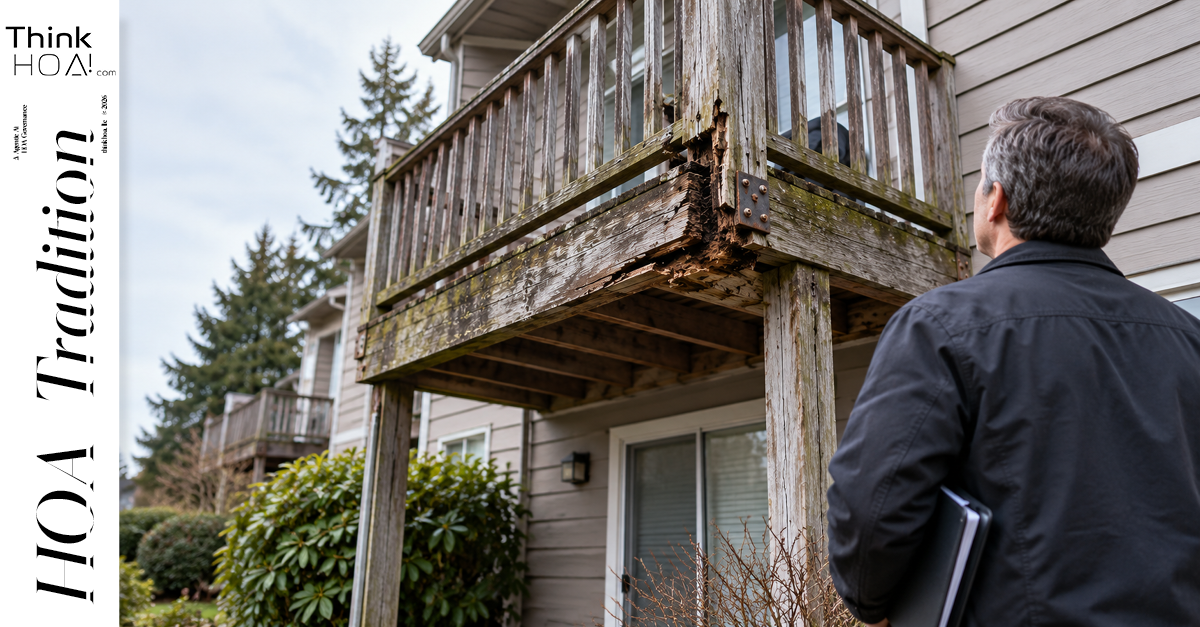
For years, an HOA relied on tradition to assign deck responsibility—until rotting railings exposed why governing documents must be read in full context.
← Back to ResourcesFor years, the association operated under a simple understanding: owners were responsible for maintaining their own decks and balconies.
The property was a townhome community, and one side of the complex was built into a hillside. Some of the wooden balconies stood nearly 35 feet above the ground at the third-story.
But railings? Who was financially responsible?
The railings and structural lumber began to deteriorate, the consequences of getting that responsibility wrong became more than financial.
They became a safety issue.
And every week of delay meant these properties were left standing in a life-safety situation.
The institutional memory was consistent.
Owners had always been told that the governing documents made them responsible for their decks and it was the Board setting that historic authority.
But based on what?
When boards, managers, and owners repeated the same interpretation for years, it began to feel like fact. But where did this come from?
There was language in the CC&Rs requiring owners to clean and maintain their interiors, light fixtures, balconies and decks. Read by itself, that language vaguely appeared to support the established understanding that decks were owner responsibility.
But the familiar answer was not the complete answer.
The owner-maintenance provision addressed maintenance. The reference lended itself to all levels of maintenance, including structural or full upkeep.
However, the governing documents, just one paragraph above the prior reference, assigned the association responsibility for the building’s exterior envelope and structural components. This section actually stated “decks and balconies.”
That distinction mattered. The balconies were wooden structures attached to the exterior of the buildings. Replacing deteriorated boards, posts, railings, and structural elements was not the same thing as keeping a balcony clean or performing ordinary upkeep.
Once the provisions were read in their full context, the historical interpretation did not hold. Legal counsel agreed that the association—not the individual owners—was responsible for the structural repair and replacement work.
This did not happen because anyone was trying to avoid responsibility. It happened because the same answer had been passed from one board to the next for so long that nobody thought to challenge it. In fact, the Board got their assessment from a previous Association Manager – “wrong call, dude.”
The owners maintained the decks because they had always been told the decks were theirs. The board repeated it because prior boards had said the same thing. Management inherited the same understanding. Eventually, the practice itself started to feel like the authority.
But tradition is not a governing document.
Once I read the two provisions together, I could see how the mistake had happened. One paragraph used the word “maintenance” in connection with the owners’ balconies and decks. The paragraph immediately above it placed the decks, balconies, exterior envelope, and structural components with the association.
The word “Maintenance” can carry different weight. It can be structural maintenance or cleanly maintenance. Typically, the interpretation of this word is in the context. And that context, may extend to a different section of the same, or different, document. The interpretation everyone remembered originated due to isolating one word from the rest of the document.
I took the issue to legal counsel. Counsel agreed: the association was responsible for the structural repair and replacement of the decks and balconies.
By that point, this was no longer an abstract disagreement about wording.
The decks were exposed to Idaho snow, ice, and moisture. Water had worked its way into the vertical railing posts, frozen, and accelerated the deterioration. When the railings were finally evaluated, roughly 80 percent of them had rot. Some of those balconies were nearly 35 feet above the ground.
Every week the association delayed meant people were continuing to use railings that were no longer safe.
That changed the conversation. We were not simply deciding who should replace a few boards. We were dealing with a life-safety problem created in part by years of relying on the wrong interpretation.
Correcting the documents did not instantly correct the expectations.
Owners had been told for years that the decks were their responsibility. Some had spent their own money on repairs. Now the board had to explain that the association was responsible for the structural work after all.
That is a difficult message to deliver, even when it is the right answer.
The board had to unwind a longstanding practice, explain why the interpretation had changed, address the unsafe railings, and determine how the association would pay for the work. Management was in the middle, trying to reconcile the documents, legal guidance, owner expectations, historical treatment, and the immediate need to make the buildings safe.
The governing documents ultimately controlled. But the cost of reaching the correct answer had grown because the association had not preserved how the original answer was reached.
An association should remember its decisions. But remembering only the outcome is not enough.
If the historical record had simply said, “Owners are responsible for decks,” it would have preserved the same mistake that caused this problem. A useful record needed to preserve the provisions reviewed, the relationship between them, the distinction between routine owner care and structural replacement, counsel’s guidance, and the final board decision.
That is the difference between institutional memory and Decision Memory.
Institutional memory often sounds like this: “That is how we have always done it.”
Decision Memory should answer: What did we decide? What authority did we rely on? What facts mattered? What uncertainty remained? And why did we reach that conclusion?
Those questions would have exposed the weakness in this interpretation years earlier. At a minimum, they would have given the next board and manager something more reliable than a repeated assumption.
Prior practice is relevant. Consistency matters. Owners should be able to understand what the association expects and rely on the board to apply its authority fairly.
But a practice does not become correct simply because it has been repeated for years.
This experience changed how I look at HOA history. I still want to know what a prior board decided, but I also want to see the authority and reasoning behind the decision. If that connection is missing, the association may be preserving confidence without preserving accuracy.
Tradition can inform the analysis. It should never quietly override the governing documents.
That is why ThinkHOA is being built around Association-Specific Governance Memory. The goal is not merely to save yesterday’s answer. It is to preserve enough of the record that tomorrow’s board can understand the answer, test it against the controlling authority, and make a better decision.
Memory is an ingredient; intelligence is the product.
Watch “HOA Tradition Overrides Documents” on Rick Osenga’s YouTube channel.
Continue through the ThinkHOA meeting resource cluster: